Our projects
From the stability of the stem cell genome to new diagnostics at the bedside: an overview of what we are working on now.
Jumping genes in blood stem cells
About 40% of the human genome consists of retrotransposons, so-called "jumping genes" long dismissed as junk DNA. A few families, such as L1HS and AluY, can still copy themselves into new places in the genome and disrupt genes. Blood stem cells have to keep their genome intact for a lifetime. We study how they keep these elements in check.
- Methods
- Whole-genome sequencing of single-cell-derived colonies, phylogenetics, knock-in mouse models, human HSC culture
- Partners
- Cambridge Stem Cell Institute (E. Laurenti, A.R. Green, S.J. Loughran, J. Nangalia)
- Preprint
- Deuel et al., bioRxiv 2025
How often do genes jump in blood stem cells?
We developed two methods: PEAR-TREE finds new insertions in whole-genome data from single stem cells, and PARTRIDGE detects new endogenous retrovirus insertions in bulk mouse stem cells with very high sensitivity. With them, we measured for the first time how often retrotransposition happens in healthy human and mouse blood formation. Compared with other tissues, the rate in stem cells is extremely low, but it is not zero.
Why so few?
Stem cells express a lot of retrotransposon RNA, yet very few new insertions appear. We found that thrombopoietin (THPO), a key stem cell cytokine, strongly represses retrotransposons while stem cells divide, which is when they are most vulnerable. In knock-in mice whose HNRNPA1 cannot be phosphorylated, this protection is lost and insertions rise, while canonical MPL/JAK/STAT signalling stays intact.
Next: leukaemic stem cells
Loss of frequently mutated genes such as DNMT3A, TET2 or TP53 de-represses retrotransposons in other cancers. We ask whether mutant haematopoietic and leukaemic stem cells depend on alternative brakes such as the THPO/MPL/HNRNPA1 axis to avoid lethal levels of insertional mutagenesis.
Team Jeremy Deuel, Teresa OlbrichCollaboration Elisa Laurenti, Jyoti Nangalia, Steve Loughran, Anthony R. Green (all Cambridge)
Reading disease in a breath
Every breath carries hundreds of volatile metabolites. Secondary electrospray ionisation high-resolution mass spectrometry (SESI-HRMS) measures them in real time and without needles. We run two prospective clinical trials using this "exhalomics" method in patients with acute leukaemia.
This work received the SFK Candy Heberlein Award.
- Method
- SESI-HRMS, developed by Prof. M. Kohler (Pulmonology, USZ) and Prof. P. Sinues (University of Basel)
- Partners
- Prof. A. Egli, Institute of Medical Microbiology, UZH · Prof. N. Cabezas-Wallscheid, ETH Zurich
- Data capture
- Our own electronic case report form, approved by the ethics committee, with an iPad questionnaire for patients
REDEFINE: detecting fungal infections early 2024 – 2027
Invasive fungal infections of the lung, such as aspergillosis, are dangerous for patients receiving intensive induction therapy for acute leukaemia. They are hard to diagnose, and late diagnosis has serious consequences. REDEFINE tests whether breath analysis can detect them earlier. We built the bioinformatic analysis from scratch. Results are expected in 2027.
Registered at ClinicalTrials.gov NCT06537726HumRes Switzerland
EXHALE: tracking the leukaemia itself since Oct 2026
EXHALE looks for metabolic signatures of the leukaemia in breath. We take breath samples before, during and after treatment to predict response and to find new volatile biomarkers linked to outcome. Plasma and leukaemia-cell metabolomics at ETH Zurich serve as external validation. The study is single-centre at USZ and planned to run for three years.
Registered at ClinicalTrials.gov NCT07826897HumRes Switzerland
Team Jeremy Deuel, Kevin HoferCollaboration Adrian Egli (UZH), Kohler group (USZ), Nina Cabezas-Wallscheid (ETH Zurich)
Digital haematology
Haematology diagnosis means combining microscopy, flow cytometry, cytogenetics and sequencing. Our web application Cinderella brings all of these together and has been in daily diagnostic use at USZ for more than five years. It covers AI-assisted microscopy, integrated flow cytometry reporting, molecular genetics and NGS, clinical annotation and laboratory statistics.
- In clinical use
- Cinderella (integrated diagnostics), diagnostic RNA-seq, patient-specific ddPCR MRD assays
- Coming up
- Unified AML risk stratification from ~500 cases · human vs AI blast counting · open-source RNA-seq platform
- Teaching
- BlastenBlaster, a cell-recognition game for haematology training
Team Jeremy Deuel, Sebastian HahnCollaboration Stefan Balabanov, Max Rieger (both USZ)
Past projects
COVID-19 in young adults
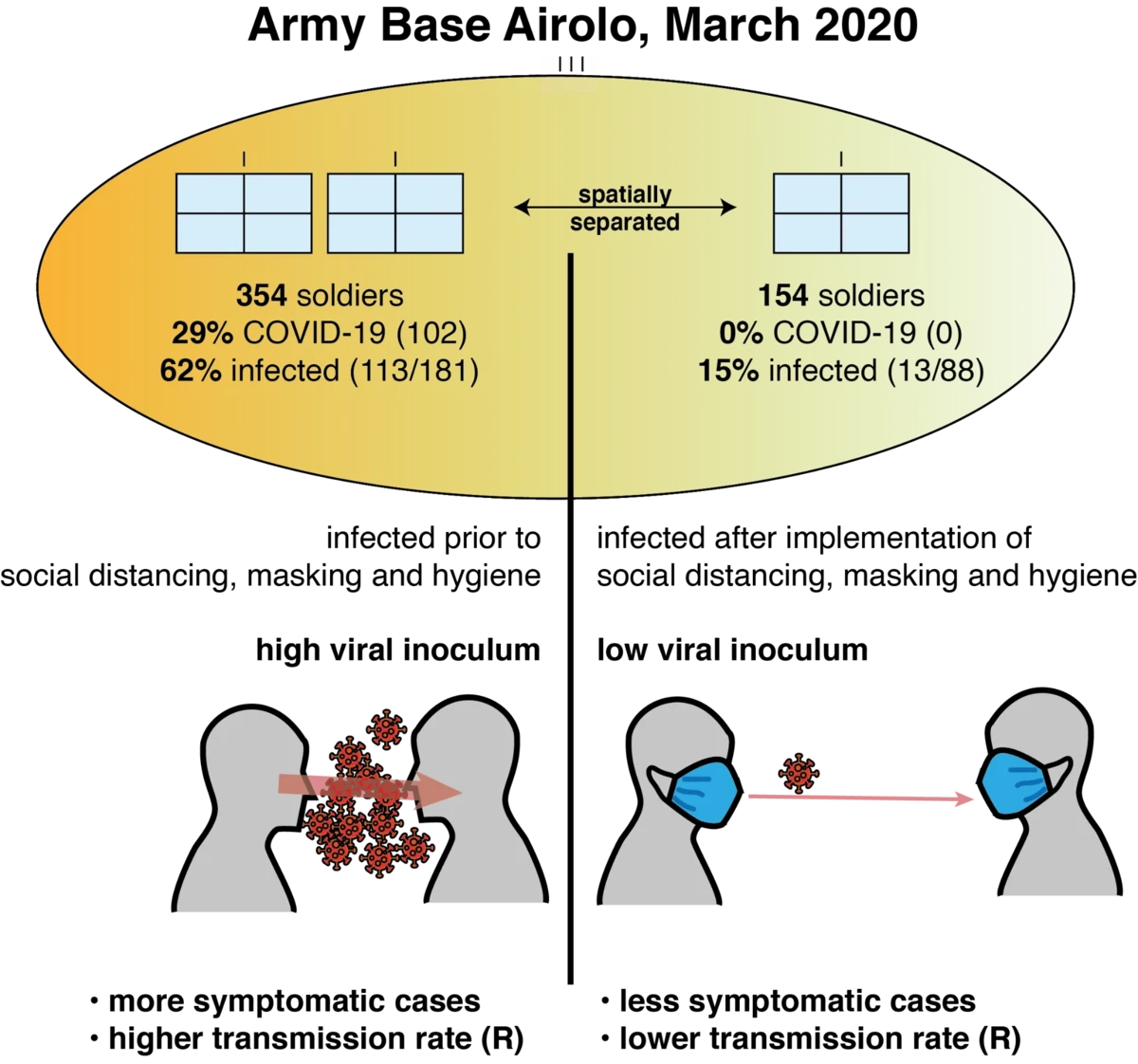
In March 2020, one of the first and fastest COVID-19 outbreaks in Switzerland hit the army base in Airolo. An ad-hoc research group on site produced some of the first descriptions of transmission, immunity and long-term sequelae in young adults, together with Dr Roland Züst (Spiez Laboratory). Soldiers infected before social distancing, masks and hygiene measures were introduced often fell ill: 29% of 354 developed COVID-19. In a spatially separated group of 154 soldiers, where the virus only arrived after these measures, 15% of those tested were infected, but nobody developed COVID-19. A lower viral inoculum seems to make the disease milder and transmission slower (Clin Infect Dis 2021). Among 199 recruits, predicted maximal aerobic capacity (VO2max) fell by a median of 0.9 ml/min/kg in COVID-19 convalescents, but not in asymptomatically infected or naive recruits.
The follow-up study LoCoMo, run with Prof. Patricia Schlagenhauf (EBPI, University of Zurich) and funded by the Swiss Armed Forces, examined 501 unvaccinated service members. More than 180 days after COVID-19, 177 previously infected participants had a higher BMI, higher cholesterol and LDL, and a lower aerobic threshold than 251 never-infected controls. This points towards a metabolic pattern, while other psychosocial, eye and sperm outcomes did not differ.
- LoCoMo Study
- Deuel et al., Lancet Infect Dis 2022
- Airolo outbreak
- Bielecki … Deuel, Clin Infect Dis 2021
Crameri … Deuel, Eurosurveillance 2020 - Assessments
- Vital signs, blood tests, immunology, cardiopulmonary exercise testing, lung function, FeNO, OCT angiography, sensory and psychological testing, spermiogram
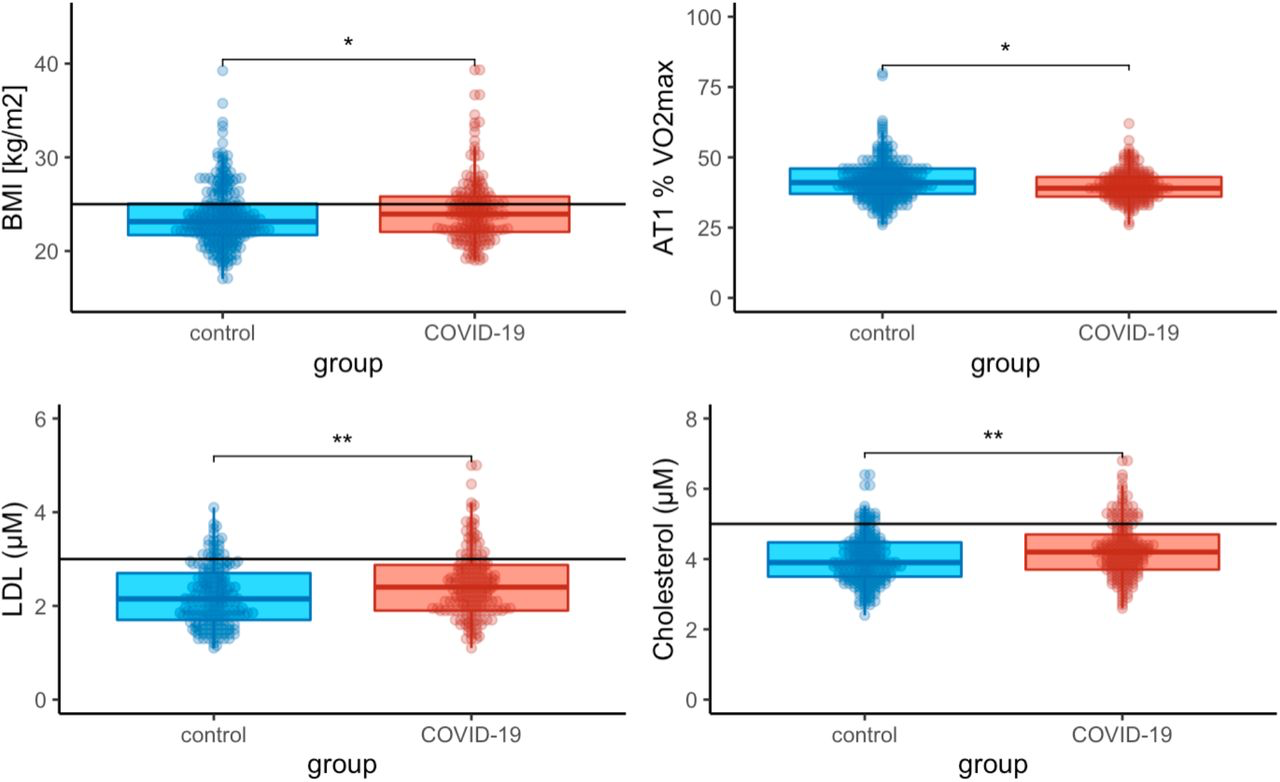
Fatigue was also slightly higher after COVID-19 (Chalder score 12 vs 11, p = 0.027); other psychosocial scores, eye findings and sperm quality did not differ.
Team Jeremy Deuel, Michel Bielecki, Giovanni A. CrameriCollaboration Patricia Schlagenhauf (UZH), Roland Züst (Labor Spiez), Sandrine Zweifel (USZ), Swiss Armed Forces